FIB, n. A lie that has not cut its teeth.
FIDDLE, n. An instrument to tickle human ears by friction of a horse's tail on the entrails of a cat.
FIDELITY, n. A virtue peculiar to those who are about to be betrayed.
Ambrose Bierce
Friday, January 19, 2007
Devil's Dictionary


Thursday, January 18, 2007
Brainstorming with myself
When the Berlin Wall went up, we were having a "going home" party in the E.M. Club for a friend and fellow Russian linguist. He was supposed to fly home the next day. But immediately we went on war alert, Kennedy gave a speech extending tours, including my friend's -- and my friend went bananas. Totally bananas. Only a great guy and understanding First Sarge saved his ass.
I have another friend who fell in love with a German woman who ended up being a spy and he defected to East Germany. He was a very good mathematician. Always have wondered what the hell happened to him. I think she was his first piece of ass. I went out with her myself, she was trying everybody out, so to speak, before deciding which vulnerable dickhead (literally) to make the move on. She was something else. Day I met her she was in a bar reading Faulkner. Jesus, did she know how to get an American college boy interested. Wonder if they had spy schools for that.
I can combine these two actual experiences into an interesting story line: the buddy, and it will be the narrator's best buddy (though I think I shouldn't do this first person -- the buddy of the protagonist, say. First person may be too restrictive.), does fall in love with the lady but when he discovers she's a spy, he breaks it off. Now, extended and angry, he has second thoughts and has a plan -- to run off with her to Spain. If she's willing to "drop out," he is. He has to ask her, to woo her, at any rate.

Fuck the Cold War, let's live on the beaches of Majorca. So he goes AWOL to find her ... and the buddy, in the chaos of the moment (and boy was it chaotic for a bunch of intellectual ivy leaguers for the most part to be on a war alert!), slips away to find him. So the entire story, after the set up, is a ticking clock, maybe WWIII has started (we all thought so at the time), and in the hunt we can break away for flashbacks about their friendship, the Army, the spies who posed as bar girls, the whole crazy black comedy of the Cold War from the perspective of a company of Russian linguists.
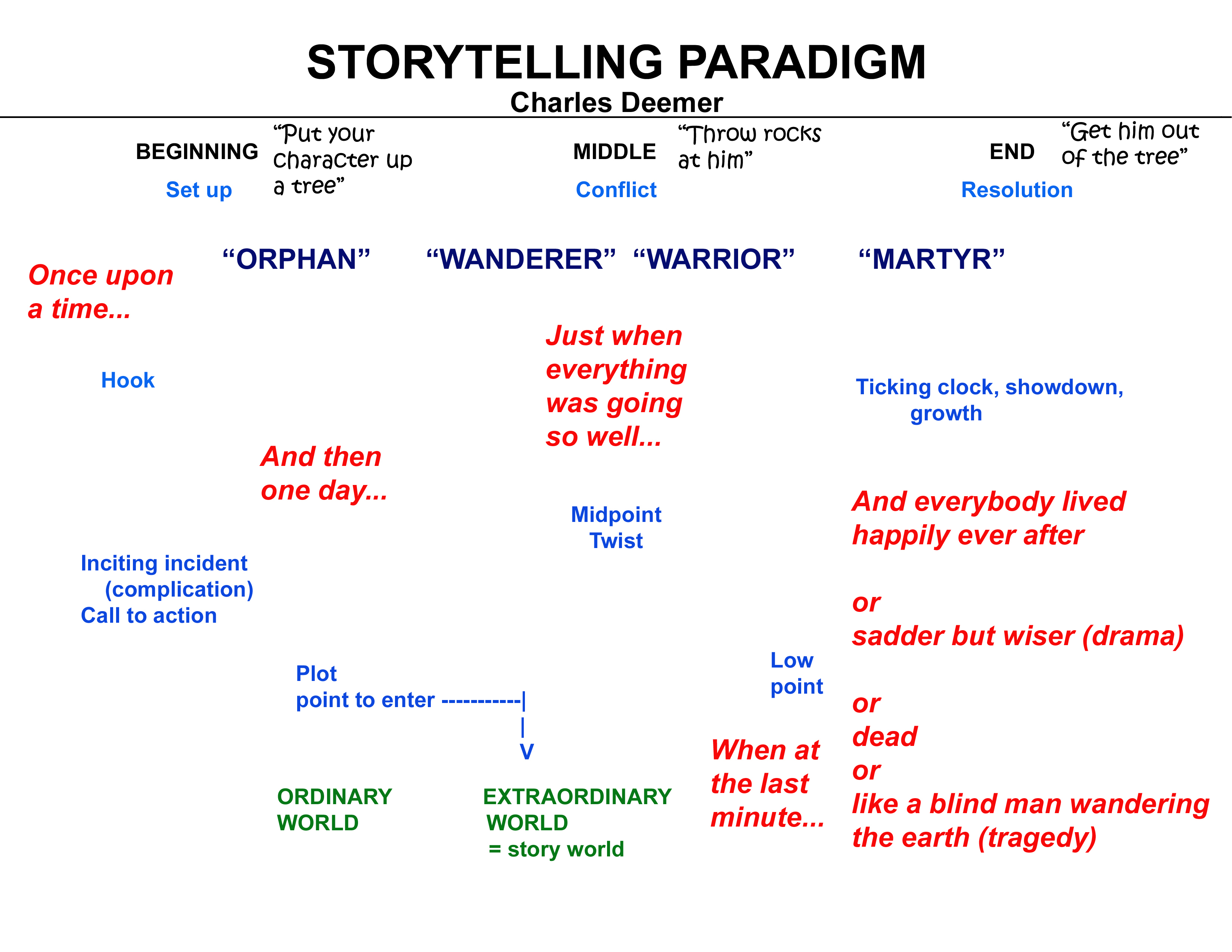
Time to see what a beginning-middle-end diagram looks like.
I have another friend who fell in love with a German woman who ended up being a spy and he defected to East Germany. He was a very good mathematician. Always have wondered what the hell happened to him. I think she was his first piece of ass. I went out with her myself, she was trying everybody out, so to speak, before deciding which vulnerable dickhead (literally) to make the move on. She was something else. Day I met her she was in a bar reading Faulkner. Jesus, did she know how to get an American college boy interested. Wonder if they had spy schools for that.
I can combine these two actual experiences into an interesting story line: the buddy, and it will be the narrator's best buddy (though I think I shouldn't do this first person -- the buddy of the protagonist, say. First person may be too restrictive.), does fall in love with the lady but when he discovers she's a spy, he breaks it off. Now, extended and angry, he has second thoughts and has a plan -- to run off with her to Spain. If she's willing to "drop out," he is. He has to ask her, to woo her, at any rate.

Fuck the Cold War, let's live on the beaches of Majorca. So he goes AWOL to find her ... and the buddy, in the chaos of the moment (and boy was it chaotic for a bunch of intellectual ivy leaguers for the most part to be on a war alert!), slips away to find him. So the entire story, after the set up, is a ticking clock, maybe WWIII has started (we all thought so at the time), and in the hunt we can break away for flashbacks about their friendship, the Army, the spies who posed as bar girls, the whole crazy black comedy of the Cold War from the perspective of a company of Russian linguists.
Time to see what a beginning-middle-end diagram looks like.
Academic womb
Out of the slush and snow and into my office! 3+ hours before class, so I should be able to get some work done. On what? At this point, I have no idea. I may try to structure a Cold War story since that wonderful material from my life has hardly been used to date. Maybe another buddy story? So many ways to go with it. The screenplay in progress, "Hitler's Blue Movie," is a romantic thriller.
And then, oh yes, dear old Sally. I sure do seem to be avoiding that. I need to reread what I have -- this usually gets me excited about it again because I usually like what I've done thus far. Sometimes it's the opposite but at this stage of my career I have a better batting average on early drafts than I did when I was younger.
At any rate, good to be in the office! So glad school wasn't cancelled today, would have made catching up harder. Not too much lost with only a day lost.
Building the Berlin Wall, August 13, 1961

P.S. When I start a new story, I usually like to embrace a different story strategy than I've used in the past. Why rehash an approach? I've never done a novel that takes place in, say, 24 or 48 hours. I may do that with the Army material. Maybe the day before and day after the Berlin Wall went up! Lots of excitement there. And I can use flashbacks to fill in stuff. Hmm. May see if I can diagram a structure around this concept. Onward.
And then, oh yes, dear old Sally. I sure do seem to be avoiding that. I need to reread what I have -- this usually gets me excited about it again because I usually like what I've done thus far. Sometimes it's the opposite but at this stage of my career I have a better batting average on early drafts than I did when I was younger.
At any rate, good to be in the office! So glad school wasn't cancelled today, would have made catching up harder. Not too much lost with only a day lost.
Building the Berlin Wall, August 13, 1961

P.S. When I start a new story, I usually like to embrace a different story strategy than I've used in the past. Why rehash an approach? I've never done a novel that takes place in, say, 24 or 48 hours. I may do that with the Army material. Maybe the day before and day after the Berlin Wall went up! Lots of excitement there. And I can use flashbacks to fill in stuff. Hmm. May see if I can diagram a structure around this concept. Onward.
Piano progress
Here are some examples of my "progress" on the piano. First, from our class song lesson book (current lesson); then something I picked up from a video; then an example of just fooling around:
Onward.
- Standing in the Need of Prayer.
- St. Louis Blues.
- Fooling around (cuts off at 60 sec.).
Onward.
Pissing names

All this snow -- still on the ground but the university is open today so later I'll put on my boots and tromp to the bus stop -- had Sketch bewildered for a bit but now he goes out to make yellow holes in the snow with the best of dogs. Watching him this morning, I recalled a pleasant memory from some 45 years ago.
As a young man I'd visit Dick in Idaho when he was going to the university there. Moscow, Idaho. When I did this in winter, we'd eventually chain up if necessary and make the trip to Orofino, his old stomping grounds. There we'd park and bar hop on foot, following paths in the snow from bar to bar. Occasionally we'd step off to virgin snow and have a race: who could piss their name in the snow more accurately? Young male buddies get off on this sort of thing, you know.
Damn, some funny things happened on these trips. I recall one time in a bar called the Jet Club, snow outside, hot toddies inside. We were talking with the bartender when an old fellow down the bar slipped off his stool and passed out on the floor. Without missing a beat of conversation, the bartender grabbed a blanket, walked around the bar, and got the old man comfortable. Folks had to step over him on their way to the can. About an hour later, the old guy snaps out of it, climbs back to the bar, and the bartender met him with, "Jake, I'm cutting you off," and phoned him a cab. Such humane treatment of drunks is something you don't see everywhere even then and surely less in our politically correct culture where such things are too horrid to understand.
Sometimes the bartender would be drunk -- they could drink then in Clearwater county. Once the bartender excused himself for a nap, leaving a jar on the bar for the honor system, which everyone obeyed. In those days, a hot toddy -- bourbon, hot water and a cube of sugar, squeeze of lemon -- cost forty cents if I remember. Maybe sixty. Around half a dollar, at any rate, which meant you could put a nice buzz on for a few dollars. Then get in the car and drive the treacherous roads back to Moscow. I didn't know anyone who didn't drink and drive in those days -- not only in the wilds of Idaho but in L.A.! The culture was different then. More responsible and better now? Well, that's a mighty easy conclusion but I think change always involves a trade off and the summation is pretty much the same. Look at all the friends I've had die during treatment for cancer, the cure worse than the disease. This is progress in medicine? To a man, they would have been better off to say, fuck it, and go have fun for a few months. Instead they were damn miserable for a few months. They still died quickly. What was the point of the treatment? Jim, the most recent victim, even considered the option of going to his favorite Puerto Rico and maxing out his credit card in the time left. Instead, miserable, miserable, miserable -- and sayonara.
Back to more pleasant things. I had more good times drinking with Dick than I can count. Of course, I also had horrid times drinking. I did some really stupid and regrettable things under the influence. At my age, I have regrets but I also have great memories of sheer fun, which I wouldn't trade for anything. These memories, the good and bad, are not mutually exclusive. They make up that shifting mosaic called "life."
Writing, pissing, our names in snow in Orofino is one of those fine memories. On to the next bar. Laughing all the way. I'm for whatever gets people laughing. Shared laughter is one of the major benefits of all good friendships.
Devil's Dictionary
FAITH, n. Belief without evidence in what is told by one who speaks without knowledge, of things without parallel.
FAMOUS, adj. Conspicuously miserable.
FASHION, n. A despot whom the wise ridicule and obey.
Ambrose Bierce
Ali turns 65


When I was in the Army, Muhammad Ali, who turned 65 a few days ago, was known as Cassius Clay. After winning the gold at the Olympics, he had turned pro, owned by a syndicate of businessmen from Louisville. The father of one of the Russian linguists in my outfit was one of these businessmen. Consequently, we became interested in the career of Clay, which we found to be an amusing name, almost as amusing as knowing someone whose father owned a prizefighter.
We were a small company of 100 linguists, stationed at various kasernes in Germany where usually there were large units of regular soldiers. They called us the Monterey Marys and we called them Animals. We tended to stay away from the bars they frequented -- often they were in the field practicing for Vietnam to come -- but now and again we got reckless. On these occasions, a bar fight usually happened, not involving us but fights nonetheless, and our pat response was always, "If only Cassius Clay were here."
We had a cartoonist in the company, and he also used Clay as a character in humorous situations, a kind of superhero who broke up bar fights. I imagine these cartoons might be worth something today. This guy also drew some amazing X-rated cartoons. He had the largest collection of scatological literature I ever knew existed, including contributions by Benjamin Franklin, who wrote an incredible short story about Queen Elizabeth passing wind, and Mark Twain.
Besides a considerable literary education, what with hanging out with colleagues who typically had M.A.'s in the humanities and had been working on Ph.D.'s as they reached draft age (and so joined to be a linguist rather than a foot soldier), I received an X-rated education in the Army, from hanging out with my colleagues to being stationed in cities like Baumholder ("sin city of Europe" according to Confidential magazine at the time), where a company sport was watching the 1000s of prostitutes arrive on trains whenever the Animals were due out of the field for a long weekend in town, to hanging out with the ladies who stayed after the Animals returned to war games, to knowing the German businessmen who ran the sex syndicates that ran this supply-and-demand enterprise, to befriending the young women, usually East German escapees, who were duped into believing they had been hired for legitimate work in the food service industry. What an experience! Amazingly enough, I still haven't done much with it in my writing. A screenplay never finished, Hitler's Blue Movie -- and a sudden urge to finish it. Several false starts on a novel. Hmm. My Cold War story remains untold, and I'm not getting any younger.
Wednesday, January 17, 2007
Sneak preview
Primus St. John has teased me with some of the things he's putting together for the poetry section of the summer review:
Nice to see him putting so much energy into this. I heard Kim Stafford may put something together about cowboy poets, too. Looking good.
- a tribute to Montana poets
- Arab women poets
- audio readings
- Native American poets
- more honored high school poets
- and more
Nice to see him putting so much energy into this. I heard Kim Stafford may put something together about cowboy poets, too. Looking good.
This Is Not A Film


This is the most engaging and entertaining "low budget" indie I've seen in some time. It shows you how a great concept, if executed with skill and cast as well as here, can go a long way. This was made on a shoestring and yet it shines, full of wit and humor, truth and suspense, Woody Allenesque with a tribute-sequence in acknowledgement of the fact. Highly recommended!
Old material, new take

In my office are three statuettes representing the "Willies" award for best original play for 1984, 1985 and 1986 (for Christmas at the Juniper Tavern, Waitresses and Chateau de Mort, my first hyperdrama). They are handsome devils! (doesn't the middle one look like Nixon?), hand-crafted by an artist who worked at Will Vinton Studios. They don't make theater awards like that in this town any more.
At any rate, I bring this up because of my 1985 play Waitresses. This was my first play at Cubiculo Theatre to start a new residency, which abruptly ended a year later when the company went under. The play also was responsible for my becoming a screenwriter. A local theater director, herself wanting to make the transition to film, wanted to option the film rights. However, on the advice of other writers, I wouldn't sell unless I wrote the screenplay, even though I knew nothing about the craft at the time. The lady finally gave in -- and over the next year and many drafts, she literally taught me how to write a screenplay while paying me for the privilege. Not too shabby.
My first draft may have been the worst screenplay ever written. For starters, the play did not lend itself to literal translation: 3 characters, 1 set. Indeed, I had decided before writing the play to have a small cast with one set, which is easier to produce. However, the notion that a film needed to open up from such restrictions was a foreign concept to me at the time.
Jennifer O'Neill

To make a long story short, we finally got a screenplay, called Ruby's Tune, that worked for us both. For the next several years, renewing the option several times, the producer did everything in her power to make the film happen. Indeed, at one point she phoned me from Las Vegas saying it was a done deal, papers being signed in the morning. A backer got cold feet at the last minute and pulled out. So the film never happened, despite getting lots of interest along the way, including from actress Jennifer O'Neill, who wanted to use the film as a comeback vehicle. But it never happened.
Well, the screenplay I'm working on next is a reconsideration of this material, which I'm calling Like Mother Like Daughter. I'm starting from scratch. Some of the elements from Ruby's Tune will be included but I'm not going to have that screenplay, nor the original play, beside me as I write. I'm using the same basic concept, the same three main characters, but I'm trying to begin as if everything is new. We'll see how it goes. I'm using the same structure software I used on the last one, which resulted in a tight story earlier than I'm used to getting them.
Cold spell
All regional schools, including the university, are closed again today. It's not snowing or raining but it's cold enough that nothing is melting either. Here at home, we still have three inches of frozen snow on the ground. What makes the closures interesting is that there's nothing in the forecast to make the situation different tomorrow, and yet it's rare that three days in a row close schools. So we'll see. My syllabus obvious needs a lot of tweaking already, I'm not sure another missed day will make repairs any more difficult. I've already decided to cancel one of the two films we study early on.
Today, then, another day staying home, staying warm, and getting some work done. Time to take a peek at Sally.
Today, then, another day staying home, staying warm, and getting some work done. Time to take a peek at Sally.
Tuesday, January 16, 2007
A fine Danish film


Checked out Twist and Shout, the Billie August film recommended at Nurse Fusion's blog some weeks ago. A good film, and one that fools you. It starts out like a charming coming-of-age story about young love and teenage angst but innocence gets lost soon enough and in "the world of experience" we get close to tragedy until a convincing upbeat ending evolves out of the central focus of male friendship. There's a companion piece that includes the same characters earlier in life but it sounded too gritty for my mood, so I started here. Recommended.
Fred Ross, Logger Poet
Fred Ross, mentioned in my entry below on Robert Service, probably has passed by now. He never had anyone pay attention to his poetry until I met him in the early 70s. "Sally," a folklorist, collected him in a scholarly way, and later I wrote an article on him for Northwest Magazine, The Poet of Juniper Mountain and even later used some of his work in my play, Christmas at the Juniper Tavern. The play later was produced for public TV, giving Fred's logging poems even more exposure.
Some memories. When I decided to use Fred's work in my play, I had to get permission. The theater where I was resident playwright at the time was willing to pay him for the rights, so it was a big deal. Fred wrote his permission out in schoolboy print on a wide-lined Indian Chief tablet, saying something to the effect that he granted me permission to use his poems in my play, as well as in TV shows, books, motion pictures -- he had stars in his eyes!
On opening night, a wonderful fluke happened. Fred was there, dressed to the cowboy nines with a new string tie. I found myself a last minute replacement in the role of the sheriff because the actor had an opening night conflict already worked out with the director, and I was the only guy around large enough to wear the uniform. But this meant that I was the one who recited Fred's poems! I loved it, knowing he was out there. Probably the highlight of my small acting career.
Fred was in ill health last time I heard about him, some 20 years ago. I was glad to contribute to his new respect after my article came out about him, which was read statewide. Before that, his local town considered him something of the town drunk. Suddenly he was a poet! Quite a difference, he told me.
Most of his work is in some scholarly archive somewhere, which I don't have access to. But the poems in the article and play demonstrate his talent for the Service form. "Robert Service never wrote a logging poem in his life!" Fred would insist. I close without argument. RIP, Fred.
Some memories. When I decided to use Fred's work in my play, I had to get permission. The theater where I was resident playwright at the time was willing to pay him for the rights, so it was a big deal. Fred wrote his permission out in schoolboy print on a wide-lined Indian Chief tablet, saying something to the effect that he granted me permission to use his poems in my play, as well as in TV shows, books, motion pictures -- he had stars in his eyes!
On opening night, a wonderful fluke happened. Fred was there, dressed to the cowboy nines with a new string tie. I found myself a last minute replacement in the role of the sheriff because the actor had an opening night conflict already worked out with the director, and I was the only guy around large enough to wear the uniform. But this meant that I was the one who recited Fred's poems! I loved it, knowing he was out there. Probably the highlight of my small acting career.
Fred was in ill health last time I heard about him, some 20 years ago. I was glad to contribute to his new respect after my article came out about him, which was read statewide. Before that, his local town considered him something of the town drunk. Suddenly he was a poet! Quite a difference, he told me.
Most of his work is in some scholarly archive somewhere, which I don't have access to. But the poems in the article and play demonstrate his talent for the Service form. "Robert Service never wrote a logging poem in his life!" Fred would insist. I close without argument. RIP, Fred.
Robert Service

Today In Literature features Robert Service today, the exception to the rule that poets don't make any money. This versifier became a millionaire. He made half a million dollars alone on his poem, "The Shooting of Dan McGrew":
A bunch of the boys were whooping it up in the Malamute saloon;
The kid that handles the music-box was hitting a rag-time tune;
Back of the bar, in a solo game, sat Dangerous Dan McGrew,
And watching his luck was his light-o'-love, the lady that’s known as Lou.
When out of the night, which was fifty below, and into the din and glare,
There stumbled a miner fresh from the creeks, dog-dirty, and loaded for bear.
He looked like a man with a foot in the grave and scarcely the strength of a louse,
Yet he tilted a poke of dust on the bar, and he called for drinks for the house.
There was none could place the stranger’s face, though we searched ourselves for a clue;
But we drank his health, and the last to drink was Dangerous Dan McGrew.
Read more.
Robert Service is the only poet I remember my dad liking, or ever mentioning. He especially liked "The Cremation of Sam McGee":
There are strange things done in the midnight sun
By the men who moil for gold;
The Arctic trails have their secret tales
That would make your blood run cold;
The Northern Lights have seen queer sights,
But the queerest they ever did see
Was that night on the marge of Lake Lebarge
I cremated Sam McGee.
Read more.
Many dismiss this stuff as crap but you can gain admiration for the form once you try writing it yourself. Two stories relating to Robert Service's meter:
- My favorite logger poet, Fred Ross, whose work I've used in my plays, wrote in this genre:
His hickory shirt was glazed with dirt as he stepped up to the bar
Give me a shot of rockgut whiskey and the butt of an old cigar
I'm in from the cold where the vine maples grow and the dogwoods bloom in the spring
I've been in the woods for thirty years and I haven't accomplished a thing
Fred, however, got fighting mad if you compared his poems to Robert Service's. "Robert Service never wrote a logging poem in his life!" - My play Varmints has a take-off on the form, which ends the play, reading in part:
MCGUINNESS: And who had survived as well but Hiner, whom I found weeping uncontrollably under a fallen building, babbling no language I could understand. It was all I could do to keep him from running into the desert like a madman. He babbled nonstop right up to the blessed arrival of our rescuers, who looked like white angels as they rode through the charred remains of Canyon City, looking for survivors and finding only two.
I returned to Chicago and back to work for Pinkerton. Never would I have given thought to the nightmare of the Oregon wilderness again had I not found a piece in the Tribune about Hiner himself, complete with photograph, Hiner who was in London and calling himself Joaquin Miller now, decked out in buckskin like Buffalo Bill and plugging a book of poems called "Oro Oregono." In London they were calling him the Lord Byron of the West. Far across the sea, he'd become an American hero.
MILLER: "They found his bones in a deep long hole across the desert sand.
His hand clutched 'round a sterile stone, a pick ax in his hand.
But here's the telling mark, my friend — though the stench was strong and vile,
This miner felt no grief or pain — his lips were in a smile!"
MCGUINNESS: Well, he was famous enough now, I suppose, but the Hiner I remember is still the whimpering fool in the charred remains of Canyon City, and when the U.S. Army finally rose up to chase the Indians and get sweet revenge with massacres of their own, there was no Hiner heeding the call of the bugle, he was safe across the sea in buckskin.
And as for me, I was safe as well, enjoying a glass of Guinness in Chicago, and being very careful now where I smoked my pipe on a windy afternoon — for there is no temptation more treacherous than the lure of sudden insight, when knowledge comes clear in whole cloth. When such clarity happens, my friend, run from it! Run from knowledge and insight!
MILLER: "And in the desert sand beside the grave wherein he sprawled,
In careful printed hand, this very message had been scrawled:
'Yes, a sinner rotted here, whose greedy smile has vanished,
Who lusted after Oregon gold!' — that's Oro Oregono in Spanish."
MCGUINNESS: Run from the truth! — or you may find yourself drawn into a godforsaken Oregon wilderness, where anything at all can happen ...
(The LIGHTS INTENSIFY, FIERY RED, the RED washing over Miller now as well: DRUMMING RISES, we hear the sounds of plaintive CHANTING AND DRUMMING, the Native American Blues, as both men are washed in RED LIGHT. Hold: and BLACKOUT. The play is over.)
I love the form myself, and I think Robert Service remains the master of the meter he made so popular -- and which made him so rich. High brow and low brow each has its place.
Why do I hate snow?


The older I get, the more I dislike cold weather, winter, ice and snow. I think it's because my Texas/LA genes take longer to get warm in winter. And because I slip and fall easier, and hurt more when I do. Yeah, sure is pretty, but I'd rather admire it on a postcard. I really do need to move where there is no or little winter and especially no snow. Unfortunately, this would require a divorce. But I'm thinking about it!
Above are two snapshots from walking around the neighborhood. H is still out there, a Massachusetts gal loving this stuff.
This morning I rewrote the screenplay. I think it's in pretty good shape. Also signed the agent's contract and assembled things she needs, like synopsa (?), proof of WGA registration. I'll mail it when I can get to the post office. No telling when that is. We ended up with 3 or 4 inches of snow and it's not going away soon. In fact, when it freezes tonight, it may be worse out here tomorrow. Maybe by Thursday afternoon, my next trip to the university, we'll be out of this mess.
I really do hate winter.
Snow
Snowing pretty hard outside, with accumulation, but I doubt if my afternoon class will be cancelled. I probably will have to tromp through the snow to the bus stop, however.
Here's today's wit from Ambrose Bierce's "The Devil's Dictionary," a giant in its genre:
Here's today's wit from Ambrose Bierce's "The Devil's Dictionary," a giant in its genre:
EPITAPH, n. An inscription on a tomb, showing that virtues acquired by death have a retroactive effect.
ERUDITION, n. Dust shaken out of a book into an empty skull.
ETHNOLOGY, n. The science that treats of the various tribes of Man, as robbers, thieves, swindlers, dunces, lunatics, idiots and ethnologists.
EULOGY, n. Praise of a person who has either the advantages of wealth and power, or the consideration to be dead.
Ambrose Bierce
Monday, January 15, 2007
Ullie@phishing.scam
Did a first, quick rewrite of the new screenplay on the computer, now printing it out for a slower, more careful reading and revision. It's in good shape, no doubt because I outlined it first, using/trying new software for this task. I like the software. I think I'll use it on the next one, too.
I should be able to wrap this up this week and get right into the next one. I have them lined up like ducks.
But, the harder task, I need to get back to Sally and not use the fun of screenwriting as an escape from its considerable challenge. Onward.
I should be able to wrap this up this week and get right into the next one. I have them lined up like ducks.
But, the harder task, I need to get back to Sally and not use the fun of screenwriting as an escape from its considerable challenge. Onward.
Devil's Dictionary
EMANCIPATION, n. A bondman's change from the tyranny of another to the despotism of himself.
EMOTION, n. A prostrating disease caused by a determination of the heart to the head. It is sometimes accompanied by a copious discharge of hydrated chloride of sodium from the eyes.
ENVELOPE, n. The coffin of a document; the scabbard of a bill; the husk of a remittance; the bed-gown of a love-letter.
ENVY, n. Emulation adapted to the meanest capacity.
Ambrose Bierce
Sunday, January 14, 2007
Devil's Dictionary
EDIBLE, adj. Good to eat, and wholesome to digest, as a worm to a toad, a toad to a snake, a snake to a pig, a pig to a man, and a man to a worm.
EDUCATION, n. That which discloses to the wise and disguises from the foolish their lack of understanding.
EGOTIST, n. A person of low taste, more interested in himself than in me.
ELECTOR, n. One who enjoys the sacred privilege of voting for the man of another man's choice.
Ambrose Bierce
Subscribe to:
Posts (Atom)