Tuesday, January 23, 2007


Oscars
List of nominations.
I'm not as excited about anything this year as I was about Crash last year. I'm pulling for Helen Mirren and Forest Whitaker but otherwise, eh?
I'm not as excited about anything this year as I was about Crash last year. I'm pulling for Helen Mirren and Forest Whitaker but otherwise, eh?
Monday, January 22, 2007
You gotta love this guy

At 69, Anthony Hopkins feels like a film rebel
By Bob Tourtellotte Mon Jan 22, 4:06 PM ET
PARK CITY, Utah (Reuters) - He's an Oscar-winning actor with roles such as serial killer Hannibal "the cannibal" Lecter, but at age 69,Anthony Hopkins said he has arrived at a new, rebellious stage of life directing low-budget art films.
Hopkins' "Slipstream," which premiered this weekend at the Sundance Film Festival, marks the veteran actor's debut as a first-time filmmaker and is part of a new edition to Sundance called "New Frontier" where art and cinema collide.
"Yeah, I'm a rebel. I want to poke people, not to cause pain, but just make people wake up," Hopkins told Reuters late on Sunday. "I feel I've arrived. I feel I'm starting anew ... I got a feeling I can be a guerrilla movie director."
Read the story.
QB & Coach

Down 21-3, then 21-6 at halftime, Colts coach Tony Dungy wasn't worried. The coach's calm demeanor rubbed off on quarterback Peyton Manning.
"He's calm on the opening kickoff, and he's calm when you're down 21-3. How many guys can say that?" Manning said after Sunday's game. "He's just a cool customer, and I think that really spreads through the rest of the team."
Really clone this day
I'm giddy. I think it's because, 40 years after the first attempt, I may finally have a handle on my Army material. I have an entire novel story-boarded, which lets me write with a strong sense of security. This is especially helpful with material I've been wrestling with since the late 1960s. I've had about four or five false starts on "my Army novel" and two false screenplay starts. But all those were forest writer attempts, confident I would figure things out along the way. I didn't. So I took the time and grunt work to think through a beginning-middle-end story, using the helpful software I've mentioned, and wah-lah! I have it all down. Sure, I also see where things are going to change a bit, but a story board is like a map, I may take a side trip but I always know how to get back on the interstate. When writing is as secure as this, it's more fun.
Off to mail some books and the post office was as crowded as at Christmas. Wonder why. I used the self-serve machine, no hassle for me, but a very long line to the counters stretched a very long ways. Did my business, bought a coffee, cruised a bit to a nice Milt Jackson tune, and came on home. Some student work to read this afternoon.
Off to mail some books and the post office was as crowded as at Christmas. Wonder why. I used the self-serve machine, no hassle for me, but a very long line to the counters stretched a very long ways. Did my business, bought a coffee, cruised a bit to a nice Milt Jackson tune, and came on home. Some student work to read this afternoon.
Clone this day
A relaxed morning in which I somehow managed to get a ton of writing done. Already 2700 words into the Cold War novel. The morning quiet, low key, focused. Sunny and cold outside, keeping me inside and warm.
Arthur Miller v. Thornton Wilder
From Today In Literature:
The Skin Of Our Teeth, in which prehistoric animals are characters

While Wilder's optimism has long been out of fashion, his dramaturgy continues to be more "modern" than many American plays you see today. Wilder had a greater influence on European playwrights than American, many of whom still write plays in a way that would better be served on film. I have never seen the point of writing a play that would make a better film. A theatrical method is what sets good plays apart, in my view. You can't make a good film from The Skin Of Our Teeth (unlike Miller's work, which uses a more old-fashioned dramaturgy); the best you can do is film the play.
On this day, fifteen years apart, Arthur Miller's The Crucible (1953) and Thornton Wilder's Our Town (1938) premiered. Although both were poorly reviewed to start, The Crucible would win a Tony and Our Town a Pulitzer; and both would become not only classics of American theater, but classic, opposite statements on the idea of community living.
Read the story.
The Skin Of Our Teeth, in which prehistoric animals are characters

While Wilder's optimism has long been out of fashion, his dramaturgy continues to be more "modern" than many American plays you see today. Wilder had a greater influence on European playwrights than American, many of whom still write plays in a way that would better be served on film. I have never seen the point of writing a play that would make a better film. A theatrical method is what sets good plays apart, in my view. You can't make a good film from The Skin Of Our Teeth (unlike Miller's work, which uses a more old-fashioned dramaturgy); the best you can do is film the play.
Devil's Dictionary
GALLOWS, n. A stage for the performance of miracle plays, in which the leading actor is translated to heaven. In this country the gallows is chiefly remarkable for the number of persons who escape it.
GENEROUS, adj. Originally this word meant noble by birth and was rightly applied to a great multitude of persons. It now means noble by nature and is taking a bit of a rest.
GHOST, n. The outward and visible sign of an inward fear.
Ambrose Bierce
Sunday, January 21, 2007
It's Bears-Colts
INDIANAPOLIS (AP) -- A comeback, a drive, a legacy. And yes -- finally -- Peyton Manning gets his Super Bowl trip, too.
Football's most prolific quarterback put on a show for the ages Sunday, rallying the Indianapolis Colts from 18 points down and driving them 80 yards for the winning score in a wildly entertaining 38-34 victory over the New England Patriots.
Read story.

I came into the play-offs rooting for the Saints and Colts, and for a moment late in the 2nd half of game two, it looked very much like a Bears-Patriots Super Bowl. Then the Colts put together their astounding comeback, exciting and nail-biting to watch, the Patriots refusing to roll over, the game going down to a Colts interception to stop the final drive at the end. Exciting stuff. And Peyton Manning, a jock with lots of class, gets a monkey off his back, the reputation of blowing big games. History was made: not only the largest comeback in a playoff game, not only the first black coach going to a Super Bowl, but two black head coaches going, who happen to be good friends. It should make for an exciting game.
Writing methods
One of the best kept secrets in the creative writing teaching industry is that 90% of the books present a method that's not the only way to do it. That is, they say plan before you start writing. In fact, many successful writers don't do much planning at all. They start with a vague notion of something and start right in writing, working things out along the way. Nobel prize-winning playwright Harold Pinter, for example, has written that he starts with two people in a room. Ten pages later he knows whether or not he has a play. This is not planning: this is full stream ahead, sink or swim, trusting in the magic of the process.
So I emphasize in my own classes that there are two ends of the method spectrum, the planners and the sink-or-swimmers. I call them the tree method and the forest method, tree as in starting small and building a forest, forest as in starting large and trying to find the trees.
In my own career, I've been mainly a forest writer, a sink-or-swimmer. Since there are so few textbooks for us, I wrote my screenwriting family of textbooks, beginning with the electronic Screenwright and ending with the Focus published Practical Screenwriting, to fill this gap.

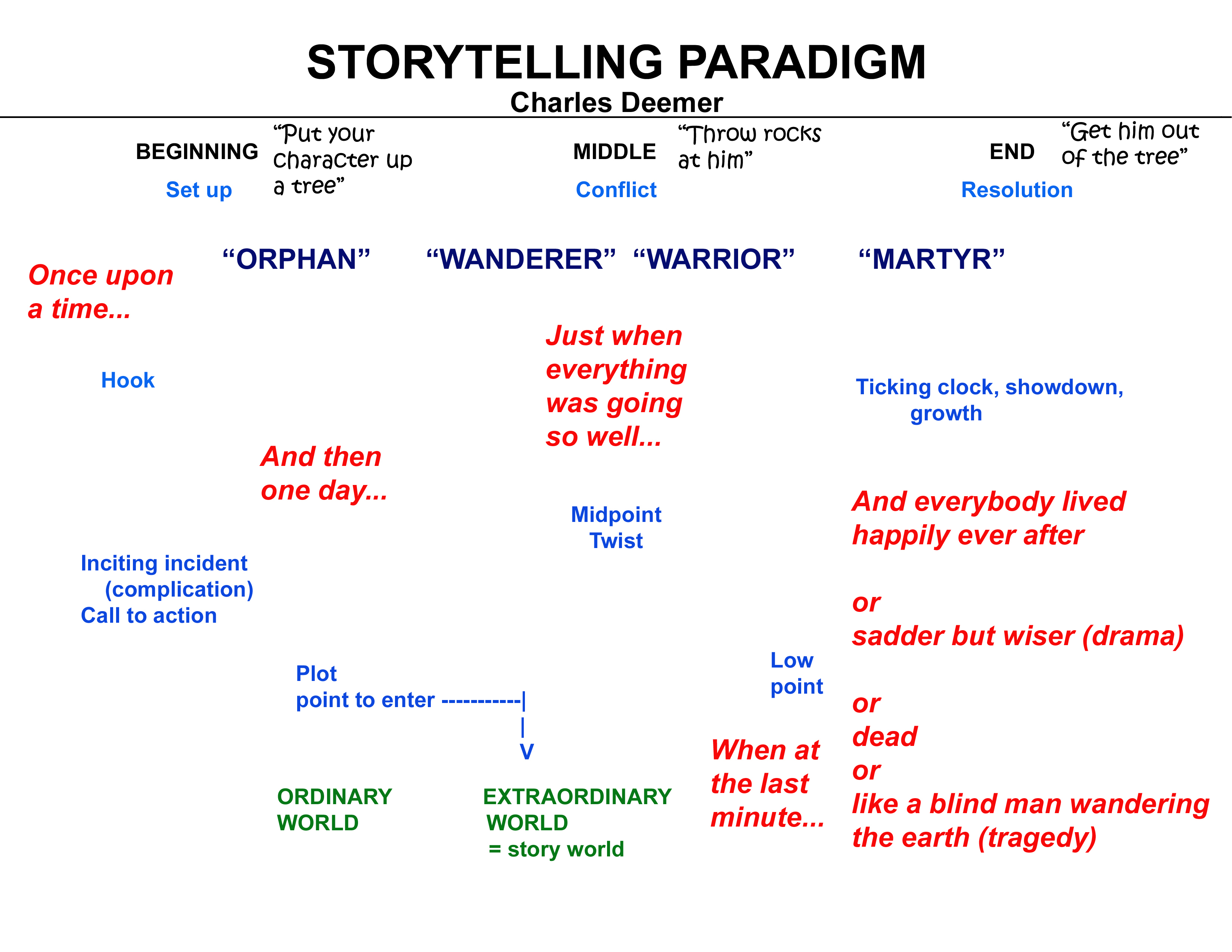
However, as I've aged, I feel I don't have the messy leisure to develop a work that's the forest agenda. I've tried to plan more and earlier in order to reduce the time it takes to finish a project. To this end, I've discovered a tool I really like, the structure software called Save the Cat!, based on the book by Blake Snyder. His method is compatible with my own structural paradigm presented in my books. What I especially like about the software is that it requires an orderly development of story structure, finishing one part of the process before you're permitted to go to the next. The most fun is the last part, moving around colored index cards on the screen, creating a story board. I enjoy doing this -- and when I'm done, I print out what amounts to a sequence outline of the entire story, which then serves as a security blanket during writing. I may still stray from it but I always have a reference of where to return.
I developed a story board for the Cold War novel and now am beginning to write it. I moved Sally back burner while I do this, a story that's been giving me a lot of trouble -- one I've attacked as a forest person, bullying forward. I think what may be helpful is to look at Sally through the tree lens of the software and develop a storyboard for it. Then when I'm done with Baumholder I can turn to it, hopefully with a full sense of my story for the first time.
If you like to plan, or get lost when you don't plan, you might want to check out the software and book.
So I emphasize in my own classes that there are two ends of the method spectrum, the planners and the sink-or-swimmers. I call them the tree method and the forest method, tree as in starting small and building a forest, forest as in starting large and trying to find the trees.
In my own career, I've been mainly a forest writer, a sink-or-swimmer. Since there are so few textbooks for us, I wrote my screenwriting family of textbooks, beginning with the electronic Screenwright and ending with the Focus published Practical Screenwriting, to fill this gap.

However, as I've aged, I feel I don't have the messy leisure to develop a work that's the forest agenda. I've tried to plan more and earlier in order to reduce the time it takes to finish a project. To this end, I've discovered a tool I really like, the structure software called Save the Cat!, based on the book by Blake Snyder. His method is compatible with my own structural paradigm presented in my books. What I especially like about the software is that it requires an orderly development of story structure, finishing one part of the process before you're permitted to go to the next. The most fun is the last part, moving around colored index cards on the screen, creating a story board. I enjoy doing this -- and when I'm done, I print out what amounts to a sequence outline of the entire story, which then serves as a security blanket during writing. I may still stray from it but I always have a reference of where to return.
I developed a story board for the Cold War novel and now am beginning to write it. I moved Sally back burner while I do this, a story that's been giving me a lot of trouble -- one I've attacked as a forest person, bullying forward. I think what may be helpful is to look at Sally through the tree lens of the software and develop a storyboard for it. Then when I'm done with Baumholder I can turn to it, hopefully with a full sense of my story for the first time.
If you like to plan, or get lost when you don't plan, you might want to check out the software and book.
Devil's Dictionary
FRIENDLESS, adj. Having no favors to bestow. Destitute of fortune. Addicted to utterance of truth and common sense.
FRIENDSHIP, n. A ship big enough to carry two in fair weather, but only one in foul.
FUTURE, n. That period of time in which our affairs prosper, our friends are true and our happiness is assured.
Ambrose Bierce
Saturday, January 20, 2007
The Last King of Scotland


Anticipating Oscar buzz for Forest Whitaker's performance, this film finally returned to town after coming and going in a flash the first time. The performance is incredible indeed but the movie is damn good in its own right. Not always easy to watch but powerful.
Moving forward
Have a pretty good take on the structure of the first two acts of the Cold War story, beginning and middle, and a sense of my ending ... enough, I think, to start writing, fiddling with the opening sentence and paragraph to find the right voice for this. I'll print out the electronic cards I arranged for structure as my security blanket. First, though, a break -- all this thinking is very tiring.
I'm reminded of the studio producer back in the days when screenwriters worked in-house, telling another producer his writers were all lazy, all he ever saw them doing was staring out the window.
I'm reminded of the studio producer back in the days when screenwriters worked in-house, telling another producer his writers were all lazy, all he ever saw them doing was staring out the window.
College sports
I love sports, love watching competitions, used to participate in sports. However, at the college level, sports have been ruined by a variety of corrupt practices all spinning around the huge amounts of money made from them. This is especially true in the major college sports of football and basketball. Colleges have provided a free farm system for the NFL and NBA. Professional baseball teams have to develop their talent through a farm system of minor leagues that they pay for -- but not football and basketball. This needs to be changed.
I know how to correct the mess of college sports. However, what I propose will never happen in a zillion years. But here are the steps anyway:
Let professional sports solve their own problems. Why should colleges give the NFL and NBA a free ride, a free farm system for developing their future jocks? What I propose will never happen. But what can happen is for the colleges to demand that the NFL and NBA pay for this farm system they provide. Let the pro teams, not the colleges, pay for the scholarships.
Make education about education, the way it was 100+ years ago when the biggest football game of the year was Harvard against Yale. Now that's what sports is about. Harvard against Yale. Cal Tech against Whittier (a rivalry in which I participated). Put the right perspective on college sports again.
Dream on, Deemer, dream on.
I know how to correct the mess of college sports. However, what I propose will never happen in a zillion years. But here are the steps anyway:
- Ban all scholarships in all college sports. Don't pay anyone anything to come to college to play a game. This does several things: it immediately divorces college sports as a farm system for professional sports. It re-establishes the focus on higher education, which is what colleges should be about. It introduces what smaller colleges know, and in fact most NCAA athletes know, that sports can be and should be about other things than training for a professional sports career. Those who want to turn pro will be left in the dark -- but not for long because this will force the NFL and NBA to develop their own farm systems and minor leagues in which to develop their jocks, rather than getting a free ride from the colleges. What about all the lost revenue to the colleges from TV rights and other things? Tough. Live with it. Colleges are not about sports as a business. Colleges are about sports as recreation for students.
- Redefine league play locally, the way high schools do. Don't travel 3000 miles in order to play a game when you can play a game with the college across town. Big school, little school, who cares? Make sports more about recreation than about winning -- at the college level. Create healthy cross-town rivalries where none exist because neighbor schools are in different leagues. Define leagues locally.
- Make an equal plane for all sports. Colleges should support tennis as much as football, crew as much as basketball, and with no scholarships and no free farm system for the major sports, the entire stresses on the sports budget change. Student-athletes gain equality, one recreational activity as good as another.
- Pay coaches no more than you pay other "professors" who teach a subject. Teaching football is not more valuable than teaching history or literature or mathematics or home economics or engineering or water coloring or marketing.
Let professional sports solve their own problems. Why should colleges give the NFL and NBA a free ride, a free farm system for developing their future jocks? What I propose will never happen. But what can happen is for the colleges to demand that the NFL and NBA pay for this farm system they provide. Let the pro teams, not the colleges, pay for the scholarships.
Make education about education, the way it was 100+ years ago when the biggest football game of the year was Harvard against Yale. Now that's what sports is about. Harvard against Yale. Cal Tech against Whittier (a rivalry in which I participated). Put the right perspective on college sports again.
Dream on, Deemer, dream on.
3 a.m.
I've always liked this hour. In my wilder days, it's when I'd go to Quality Pie for breakfast after the bars closed. In my less frantic years, it's when I often get up after crashing early to do a bit of work. Everything is quiet and still. The dog loves to hop into bed and take my warm spot, and when I return for a few more zzz's after writing, I'll have to nudge him over to make room for me.
I had planned to work on act two of Baumholder but instead responded to some story matters regarding Julie's novel, which I'm brainstorming with her. Spent about an hour on that, and now I may return to bed. I like to listen to Scott Simon at 5.
Today is free, and I should be able to make more progress working out the sequence cards of the new novel. Sally, alas, is in a holding pattern, as complex work often is, off and on, through its difficult development. I'm not abandoning it, just setting it aside in the heat of new excitement for my long belated Army novel. I think I have found the key this time, after numerous false starts over the past thirty or forty years. Bringing together those three experiences: the Berlin wall extensions, the defection, the local Nazis farmers. I have personal experience about the dramatic elements that will drive this story.
I also like the way the structure is developing. Looking for the buddy, trying to talk sense to him, intermingled with flash backs of how they got there.
What is yet unresolved is the voice. Which, of course, is pretty much everything in a novel. I typically am leaning toward choices that reduce the commercial appeal of this, always bending toward art rather than commerce, it's a damn disease with me ha ha. I may take some real risks with the voice and try things I've never tried before. A kind of pompous Norman Mailer voice. A dark voice. We are in, after all, the Sin City of Europe for this story. Greed, corruption, exploitation, sex, it's all here with our blue-eyed earnest young Americans from the heartland as witness first and soon enough participants. Baumholder is the corruption of American Gothic.
So what I'll be doing is trying out first paragraphs in different voices. Or maybe only first sentences! For example, "May the gods protect the Mothers of America from learning what their blue-eyed sons are up to in the Enlisted Men's Club tonight." This is the opening rattling in my brain at the moment. The thought may belong to the narrative voice ("God") -- or to a character, say a sergeant who enters the going-home party with the news that Kennedy just extended the poor SOB.
I'll know it when I get something that sounds right to me. But I think the voice here will be as defining as the voice in, say, The Sound and the Fury, a voice-defined story. The way the story is told is as important as the story itself.
This is going to be a fun, challenging journey. Onward.
I had planned to work on act two of Baumholder but instead responded to some story matters regarding Julie's novel, which I'm brainstorming with her. Spent about an hour on that, and now I may return to bed. I like to listen to Scott Simon at 5.
Today is free, and I should be able to make more progress working out the sequence cards of the new novel. Sally, alas, is in a holding pattern, as complex work often is, off and on, through its difficult development. I'm not abandoning it, just setting it aside in the heat of new excitement for my long belated Army novel. I think I have found the key this time, after numerous false starts over the past thirty or forty years. Bringing together those three experiences: the Berlin wall extensions, the defection, the local Nazis farmers. I have personal experience about the dramatic elements that will drive this story.
I also like the way the structure is developing. Looking for the buddy, trying to talk sense to him, intermingled with flash backs of how they got there.
What is yet unresolved is the voice. Which, of course, is pretty much everything in a novel. I typically am leaning toward choices that reduce the commercial appeal of this, always bending toward art rather than commerce, it's a damn disease with me ha ha. I may take some real risks with the voice and try things I've never tried before. A kind of pompous Norman Mailer voice. A dark voice. We are in, after all, the Sin City of Europe for this story. Greed, corruption, exploitation, sex, it's all here with our blue-eyed earnest young Americans from the heartland as witness first and soon enough participants. Baumholder is the corruption of American Gothic.
So what I'll be doing is trying out first paragraphs in different voices. Or maybe only first sentences! For example, "May the gods protect the Mothers of America from learning what their blue-eyed sons are up to in the Enlisted Men's Club tonight." This is the opening rattling in my brain at the moment. The thought may belong to the narrative voice ("God") -- or to a character, say a sergeant who enters the going-home party with the news that Kennedy just extended the poor SOB.
I'll know it when I get something that sounds right to me. But I think the voice here will be as defining as the voice in, say, The Sound and the Fury, a voice-defined story. The way the story is told is as important as the story itself.
This is going to be a fun, challenging journey. Onward.
Friday, January 19, 2007
What the future holds

My new agent for screenwriting also handles fiction, so she'll get first crack at the Cold War novel (if we still have a relationship by the time I finish it). But I think of it as looking something like here.
I worked out the ten sequences of act one today, using the 40 sequence, 15 beat software system I'm beginning to like the more I use it. It's quite compatible with the structure tools in my own book. Even though it's a novel, I'm structuring the story like a screenplay. Things change in the heat of writing but this gets the buggy in flight with a sense of security once you work out all the cards. I'm using different color cards for different time lines. Looks out nicely. Even looks pretty ha ha.
I'm going to do something crazy with the tone of this. I can feel it coming.
Big Mick's Rock-n-Roll

Big Mick found my essay Birthing Little Richard about being a teenager at the birth of rock and roll -- could there possibly be a better time!? -- which he's incorporating into a documentary film he's working on about the "untold history" of rock. This morning he requested a photo of me from those days ... and I found this one here. Do I look like a nerd?
Big Mick's Website.
Baumholder, 1961

This is my working title for the Army novel, and I'm moving it front burner despite Sally in progress. The latter is a damn difficult book, the emotional journey complex and layered, which makes the Cold War story straightforward in comparison. I'll continue brooding about Sally and maybe even write on it now and again but I think I can dash off this long belated story based on my Army experiences with relative ease.

I'm using the software to outline the plot. The major unsolved questions are voice and point of view. Pretty sure I'm going 3rd -- I think maybe I'd like to switch POVs between the two buddy characters, get it from their perspectives. I also might jazz up my writing style more than my usual understated prose. Not sure. Or maybe better, change style between the two characters, to match their personalities. One subdued, one flamboyant. I think I have my ending, too. Onward.
More backdrop
I found this on the web:
This is where I came as a young soldier in 1960. A farm community of 2000 (Baumholder) had become a G.I. playground for 30,000 soldiers, with dozens and dozens of bars along its main street. We were a small outfit of 100, isolated from the other soldiers. The "real soldiers" spent most of their time in the fields, practicing war (for Vietnam, it turned out), but when they came into town with a weekend pass, nonstop trains hauled in prostitutes from all over Germany to "serve" them. I can only describe the experience at the train station, watching the hundreds of girls parade in, as surreal. This is the setting of my Cold War story.
In October 1952, the German Bundestag declared a large stretch of Rhineland-Palatinate—a poor, rural state in the southwest of Germany—to be a moral disaster area.[1] The legislators resorted to this dramatic step because the buildup of American military personnel in West Germany in the wake of the Korean War had allegedly wrecked havoc in the provinces. The American troop deployment, they complained, instead of creating a bulwark against Soviet expansionism, had brought striptease parlors, prostitution, common-law marriages, and unprecedented levels of illegitimacy.
This is where I came as a young soldier in 1960. A farm community of 2000 (Baumholder) had become a G.I. playground for 30,000 soldiers, with dozens and dozens of bars along its main street. We were a small outfit of 100, isolated from the other soldiers. The "real soldiers" spent most of their time in the fields, practicing war (for Vietnam, it turned out), but when they came into town with a weekend pass, nonstop trains hauled in prostitutes from all over Germany to "serve" them. I can only describe the experience at the train station, watching the hundreds of girls parade in, as surreal. This is the setting of my Cold War story.
TGIF
Friday has been a good day for a long time, not because it's the last day of the work week but because it's the first day of my writing week when I'm teaching. And now it's also the day of my piano lesson, which I always look forward to. I think the next thing I'm going to tackle on my own is Stormy Weather, an arrangement of which I have in a music book, that looks doable at this stage (i.e. slow), and upon which I can add frills once I get it down. I like to have another piano project other than the stuff we do in class.
I spent a lot of time during office hours yesterday taking notes on the Cold War, Berlin Wall, story. I think I have something. I'm combining two personal experiences -- the buddy who went ape when he got extended during the Berlin crisis, the other buddy who defected to East Germany with a lady spy -- and now I'm adding a third, the Nazis underbrush still in Germany in the early sixties. In my experience, it worked this way.
The German police made a last stop at a gasthaus near our base about 10p.m. After they were gone, the owner went to the jukebox and put on several banned Nazis marching songs! The local farmers who frequented the place really got off on that. Moreover, another buddy of mine had put several Hitler speeches to memory, and he'd stand up on a table and recite them with great vigor, to great applause, and the German farmers bought us beer all night long. We thought it was a hoot at the time. Sounds totally frightening to me now. At any rate, in my story there will be a secret Nazis club involved in this, which can add an element of danger after the war alert goes into effect.
So three personal experiences serve as the foundation of this story. Interesting how we borrow from our lives and use experience like putty to shape a story. What I end up with will have nothing to do on the surface with what really happened, and yet it begins with, and is based on, autobiographical memories. What remains is the emotional content of the experience.
I spent a lot of time during office hours yesterday taking notes on the Cold War, Berlin Wall, story. I think I have something. I'm combining two personal experiences -- the buddy who went ape when he got extended during the Berlin crisis, the other buddy who defected to East Germany with a lady spy -- and now I'm adding a third, the Nazis underbrush still in Germany in the early sixties. In my experience, it worked this way.
The German police made a last stop at a gasthaus near our base about 10p.m. After they were gone, the owner went to the jukebox and put on several banned Nazis marching songs! The local farmers who frequented the place really got off on that. Moreover, another buddy of mine had put several Hitler speeches to memory, and he'd stand up on a table and recite them with great vigor, to great applause, and the German farmers bought us beer all night long. We thought it was a hoot at the time. Sounds totally frightening to me now. At any rate, in my story there will be a secret Nazis club involved in this, which can add an element of danger after the war alert goes into effect.
So three personal experiences serve as the foundation of this story. Interesting how we borrow from our lives and use experience like putty to shape a story. What I end up with will have nothing to do on the surface with what really happened, and yet it begins with, and is based on, autobiographical memories. What remains is the emotional content of the experience.
Subscribe to:
Posts (Atom)