... of "Waltzing Matilda".
"The struggle itself ... is enough to fill a man's heart." --Camus
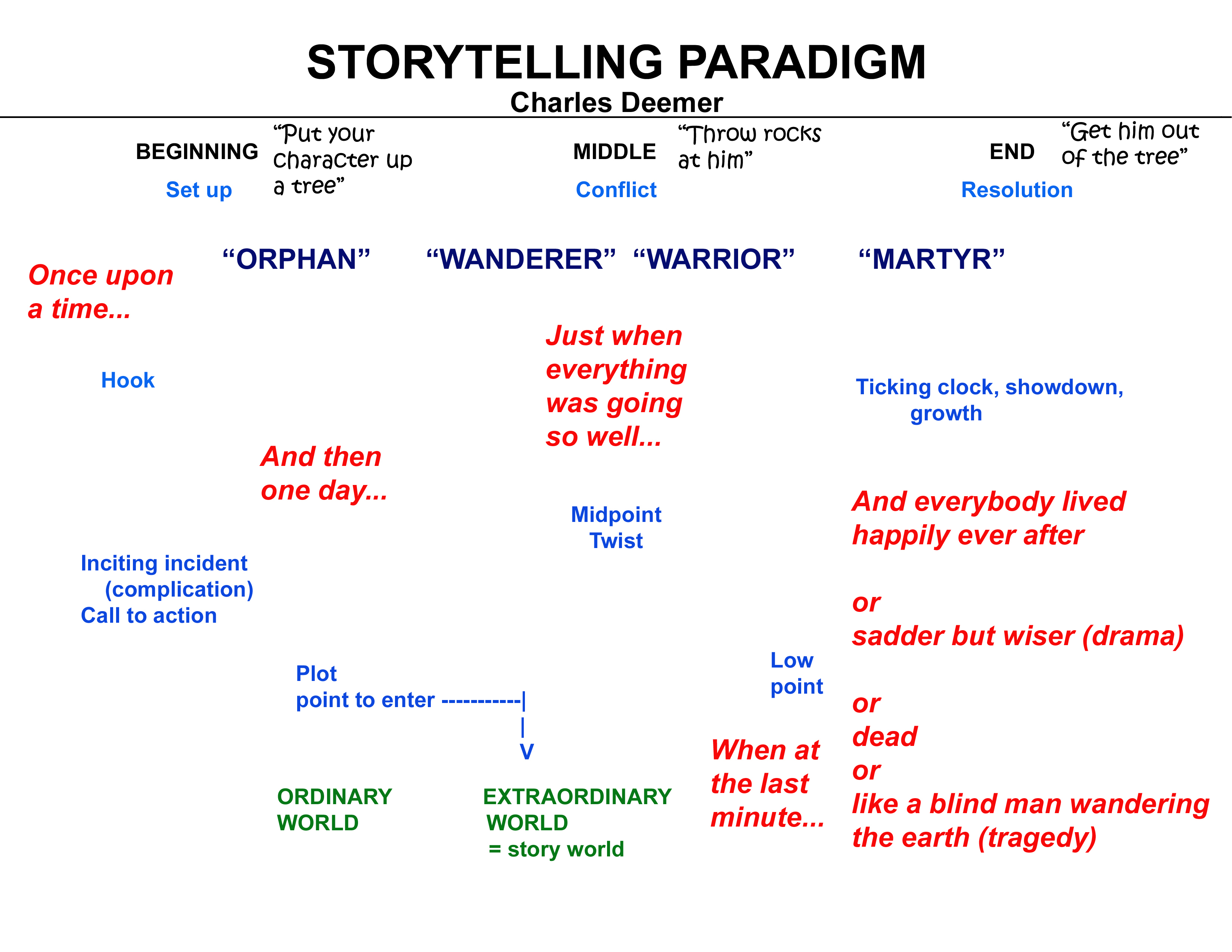
FREE SCREENWRITING TUTORIAL (click) 
"Remarkable" (London Screenwriters Workshop)
MISFORTUNE, n. The kind of fortune that never misses.
MONDAY, n. In Christian countries, the day after the baseball game.
MONUMENT, n. A structure intended to commemorate something which either needs no commemoration or cannot be commemorated.
MORAL, adj. Conforming to a local and mutable standard of right. Having the quality of general expediency.
NEIGHBOR, n. One whom we are commanded to love as ourselves, and who does all he knows how to make us disobedient.
NIHILIST, n. A Russian who denies the existence of anything but Tolstoi. The leader of the school is Tolstoi.
NOISE, n. A stench in the ear.
NON-COMBATANT, n. A dead Quaker.
NONSENSE, n. The objections that are urged against this excellent dictionary.
NOVEL, n. A short story padded.
NOVEMBER, n. The eleventh twelfth of a weariness.
Ambrose Bierce


"Win or lose, the bubble bursts and you're back to the nitty gritty of working," she told Reuters in an interview last month. "I'm honestly at my happiest in a cold rehearsal room with my polystyrene cup of tea."


LOVER & GRANDMOTHER
Love is the only good thing in life
As fleeting a thing as love can be
It burns like a flame – and goes out the same
Something to cherish as long as you can
Love is the only good thing in life
It comes like a storm and leaves like a hawk
That carries away your heart and your soul
Love is the only good thing in life


LOVE, n. A temporary insanity curable by marriage or by removal of the patient from the influences under which he incurred the disorder.
LYRE, n. An ancient instrument of torture.
MAD, adj. Affected with a high degree of intellectual independence; not conforming to standards of thought, speech and action derived by the conformants from study of themselves; at odds with the majority; in short, unusual. It is noteworthy that persons are pronounced mad by officials destitute of evidence that themselves are sane.
MAGIC, n. An art of converting superstition into coin.
MAGNET, n. Something acted upon by magnetism. MAGNETISM, n. Something acting upon a magnet. The two definitions immediately foregoing are condensed from the works of one thousand eminent scientists, who have illuminated the subject with a great white light, to the inexpressible advancement of human knowledge.
MALE, n. A member of the unconsidered, or negligible sex. The male of the human race is commonly known (to the female) as Mere Man. The genus has two varieties: good providers and bad providers.
MALEFACTOR, n. The chief factor in the progress of the human race.
MAMMON, n. The god of the world's leading religion.
MAN, n. An animal so lost in rapturous contemplation of what he thinks he is as to overlook what he indubitably ought to be.
Ambrose Bierce

Shades of the Old West: Two Ore. ranchers dead in cattle dispute
By TERRENCE PETTY
The Associated Press
PORTLAND, Ore. -- Four cows that had gone missing from their spread in Eastern Oregon led cattlemen Dennis Beach and his son, Travis, to a cousin's ranch about eight miles away.
What happened next was like a scene out of the Old West -- a tragedy of cousin against cousin, a man shot off his horse by a lever-action rifle, and two dead ranchers. It's a tale as tangled as tumbleweeds in barbed wire.
Read the story.
On this day in 1862 Elizabeth Siddal died at the age of thirty-two, almost certainly a suicide by drug overdose. Husband Dante Gabriel Rossetti discovered her body -- and, the conjecture goes, destroyed her suicide note -- after returning home from an evening out. Several days later, he was stirred by grief, guilt and his romantic temperament to the last-minute gesture of placing the only manuscript copies of many of his poems in his wife's coffin, nestled beside her cheek; seven years later, in one of the most notorious second-thoughts of love and literature, Rossetti retrieved and published the poems.
Read the story in Today in Literature.
Tuition at the University of Toronto tracked close to inflation rates during the entire period. [4] The University of Iowa had rapid increases in tuition during the 1950s and then tracked close to inflation rates since that time.[5] The Massachusetts Institute of Technology (MIT), among the most expensive of the private U.S. educational institutions throughout the 20th century,[6] had continual large tuition increases, dipping slightly below inflation rates only during the World War II years.[7] [8]
Over the 60-year period charted, the inflation-adjusted, long term, annual increases in tuition at these institutions were 0.4 percent for the University of Toronto, 1.4 percent for the University of Iowa, and 2.1 percent for MIT.[9] Other institutions in the same categories differ in details but not in general patterns.[10] The results of the trends are that over the 60 years shown, adjusted for inflation, the tuition at the University of Iowa increased by a factor of 2.3 and that at MIT by a factor of 3.6, while tuition at the University of Toronto rose only about 30 percent.[11]
The arrival of the first train changed everything. Bass did not have to watch the parade of girls long to realize this was no snipe hunt, here was an event even more surreal and dreamlike than the descriptions of his colleagues suggested. Several hundred girls spilled off the first train, marching in disorder into the train station, women varying in age from teens to forties, women of all size and description, fat and skinny and in between, pretty and plain, hardened and innocent-looking. What struck Bass first was that so many of them were younger than he was.
“They look so young,” he said to Sullivan at the table beside him.
“The youngest are escapees from East Germany,” Sullivan explained. “They think they’re taking a job as a server in a gasthaus or a waitress in a restaurant, but it’s the syndicate bringing them into their fold. Once they’re captured, it’s hard to get away. They arrive broke, often without family or friends. They risk everything for freedom and end up here. It’s a tragedy really.”
Only Sullivan’s tone didn’t suggest tragedy. His voice had the hardened neutrality of a doctor working the midnight shift in an emergency room, who has seen every bodily disaster many times over. Neutrality, lack of concern, was the best defense mechanism.
“Jesus, they’re young,” Bass said again. “The one in the bluejeans can’t be over fourteen or fifteen.”
“I think there’s a law they have to be sixteen,” said Sullivan.
“Young enough.”
Some of the girls flirted as they passed but most looked tired and travel-weary. How far had they traveled to get to Baumholder just ahead of the Animals’ weekend pass? Some from as far away as Berlin, the Netherlands, even London, according to Sullivan.
No sooner had the several hundred women passed through the station than the train pulled away to make room for another behind it, and the parade of prostitutes began all over again. As the second group marched through the station, Bass heard someone shouting and turned to find a small group of young German men holding up placards in protest, though he didn’t know enough German to read them. But their manner was clear: their shouts at the women clearly meant disapproval.
Sullivan leaned close to Bass.
“See the guy waving his sign? That’s Karl, son of the proprietor of the gasthaus at the bottom of the hill.”
“Are they a religious group or what?”
“Nazis.”
“What?”
Bass stared at Sullivan in disbelief.
“Well, it’s illegal, so they have to be underground and pretend they’re something else. That D.P. on their caps stands for Patriots of the Homeland. Something like that. I forget the German exactly. Buddy would know. The thing is, this is so hypocritical because Konrad has a stake in the Family Club, yet his son is one of them. The Germans bitch about American immorality and then turn around and put the women in their clubs at starvation wages, which means they’re forced to put out on the side just to survive.”
“This is hard to handle,” said Bass. He stood up.
“Where you going?”
“To the can.”
In the men’s room he splashed cold water on his face. On the counter was a stack of neatly folded cloth hand towels, and he took one to dry himself.
So this was the infamous whore parade he’d heard so much about. The descriptions of what awaited him were too extreme to be believed – and yet they fell short of capturing the grotesque unreality of what he had witnessed. Bass had expected to be titillated but instead had escaped to the men’s room feeling light-headed and almost sick in his stomach. It wasn’t that some of the women weren’t attractive, many were – but there were too many of them, too extreme and blatant a display of commercial sex parading in front of him, he felt overwhelmed from the sensual overload of it all. This was more like a scene from a Fellini movie than an afternoon in the once-lazy farm village of Baumholder.
When he left the men’s room, he found a young woman standing outside the adjacent ladies’ room. She was crying. Bass stopped, wanting to comfort her, at least to ask if he might help, but he knew almost no German.
All the same, he asked, “Are you all right?”
She looked up, and Bass saw she was one of the younger ones, sixteen he supposed, a pretty girl, despite the swollen red eyes and grimace through which she sputtered choking words he couldn’t understand. Then suddenly she was embracing him and weeping on his shoulder.
Bass stiffened in something close to terror. He could feel the soft sensual bulge of her breasts pushing against his chest. He could feel her warm breath on his neck. He was getting excited and hating himself for it.
“Marta! Here you are!”
The deep voice belonged to a German wearing a business suit. Hearing it, the girl tightened her grip on Bass, who now tried to slip away from her grip.
“I think she is homesick,” said the German. His English was almost without accent. “Marta, come on now.”
The German pried her grip free of Bass, who quickly stepped back.
“Is she going to be all right?” he asked.
The German smiled.
“Of course, of course.”
He had his arm around her and already was leading the girl away. He spoke to her in German now, which Bass could not understand.
When they were out of sight, Bass took a deep breath. He realized he was shaking. He didn’t return to the table to watch the rest of the parade. Bass walked through town and up the hill to the kaserne. By the time Sullivan and the others found him in the E. M. Club over an hour later, Bass was pretty wasted.
LIFE, n. A spiritual pickle preserving the body from decay. We live in daily apprehension of its loss; yet when lost it is not missed.
LIGHTHOUSE, n. A tall building on the seashore in which the government maintains a lamp and the friend of a politician.
LITIGATION, n. A machine which you go into as a pig and come out of as a sausage.
LOCK-AND-KEY, n. The distinguishing device of civilization and enlightenment.
LOGIC, n. The art of thinking and reasoning in strict accordance with the limitations and incapacities of the human misunderstanding.
LOQUACITY, n. A disorder which renders the sufferer unable to curb his tongue when you wish to talk.
Ambrose Bierce

NEW ORLEANS, Louisiana (AP) -- A mother and her teenage son have been accused of second-degree murder, with police saying the mother gave him a gun after he lost a fight and told him to take revenge.
PITTSBURGH, Pennsylvania (AP) -- The father of a young girl who died of exposure had knocked her unconscious because he was angry she wouldn't go to bed, then took her outside in freezing temperatures and left her there, police said before the man's arraignment Thursday.

ROME, Italy (AP) -- It could be humanity's oldest story of doomed love.
Archaeologists have unearthed two skeletons from the Neolithic period locked in a tender embrace and buried outside Mantua, just 25 miles south of Verona, the romantic city where Shakespeare set the star-crossed tale of "Romeo and Juliet."
Buried between 5,000 and 6,000 years ago, the prehistoric pair are believed to have been a man and a woman and are thought to have died young, as their teeth were found intact, said Elena Menotti, the archaeologist who led the dig.
"As far as we know, it's unique," Menotti told The Associated Press by telephone from Milan. "Double burials from the Neolithic are unheard of, and these are even hugging."
Read the story.

He will meet her in the reception line. There will have been earlier opportunities but he’ll have missed them. There especially would have been an opportunity for a quick introduction before the film began had he been available but with lingering weakness from the recent flu, and the special honor this year of having the festival named after him, so that he too is a star of the occasion (in his own less glamorous way, as befits a professor emeritus), he will have his wife drive him to the university auditorium only moments before the film starts, letting him join the audience anonymously as people are taking their seats and saving his own dramatic introduction for later in the evening during the awards ceremony. Sandwiched between the film and the dinner, at the insistence of the student group that has done most of the festival’s grunt work, there will be a reception line at which Miss Kidman can be greeted and touched by her many adoring student fans, and it is then when he finally will meet her.
Of course, he will wait at the end of the line, the last to approach her, which suits both his position and his age. He will look her straight in the eye, eyes (he has been told) that can thrust directly to a person’s soul, eyes that have been his most attractive physical asset for as long as he can remember, as long as women have told him about such things, yes, he will look into the eyes of Miss Kidman and tell her in a voice low enough to be private:
“Miss Kidman, without question you are the most accomplished actor of your generation. The nuances of character you find in your many and varied roles continue to amaze and impress me, and for ever more I cannot think of Virginia Woolf without seeing your very face, false nose and all, as the icon of her genius. You are a great treasure not only for film lovers but for the entire world.”
As he speaks he will have taken her hand, his right grasping her right, a gentle handshake, but then his left hand will reach forward as he turns her hand horizontally so his own can spread over her small hand like a blanket, and he will have enclosed her hand in both of his, handshake becoming embrace, and he will release her only after he has finished praising her, all the while looking deeply into her eyes, locked on her very soul. It will be a moment he will remember for the rest of his life.
And that will be about it.
But wait. There appears to be more.
After the reception line everyone walks across campus to the dining hall for a sit-down dinner, after which the various awards are made that always highlight the annual student film festival, and this year there is the special achievement award to Nicole Kidman and also a special honor to the professor emeritus, which includes renaming the festival after him for all its future incarnations. And this is when Nicole Kidman will take notice of him.
Clearly she is unable to get him out of her mind, those powerful eyes of his having done their work, and she will go out of her way to corner him at the reception that ends the evening to congratulate him on his honor and ask about his work, though of course he is too modest to say much of anything about his professional life, which seems so long ago at any rate, and Miss Kidman will look into his eyes with an intensity just short of his own, and he will feel the shiver of a special bonding taking place between them, which will cut his breath short, and it will be all he can do to find his wife in the noisy, mingling crowd, she the social butterfly of the family, and he will beg her to get him out of there and home before he passes out from the sheer wonder of the evening and causes a scene.
Then, finally alone in bed while his wife stays up to see the weather report on the late night news (the third time she has watched the weather report today), he will slip into slumber while thinking of Miss Kidman. And this at last will be the end of it. Or should be.
But a miracle happens.
Not quite a year later, Miss Kidman is on location less than a hundred miles away and during a free day she gets a chauffeur to drive her to campus. She is looking for him. What an extraordinary development! Miss Kidman hasn’t forgotten him. It must be his eyes. She has come to campus to ask him to lunch and to invite him to watch her work on location tomorrow.
Of course, he seldom uses his office on campus any more, even though the university retains it for him. She is given directions to his home on the hill behind campus, a location that permits the professor emeritus to look down from his deck upon the terrain of his former pedagogical and intellectual fame.
She climbs the steps to the front porch alone, her chauffeur waiting with the vehicle at the curb. She rings the doorbell. She knocks.
As it happens, he is alone in the house. His wife, in fact, is out of town, burying her mother, who did not last in the nursing home till her hundredth birthday after all. He is alone and hears the bell and ignores it, figuring someone wants to sell him something. But the gentle knock suggests someone with a different motive. He begins a slow cross over hardwood floors to the entrance.
He opens the door. Miss Kidman is astonishingly shy and astonishingly beautiful. Also astonishingly attracted to him. Such attraction is new to her, so much sexual energy directed at a man old enough to be her father. Or even her grandfather.
He, of course, is astounded to see her. But he immediately regards her in a context even more charged than their first meeting, regarding her more personally, more intimately, because it is obvious she is there only to see him, no other motive for her appearance on his front porch making sense, which means she cannot keep herself away from him, a conclusion reinforced by the thin film of tears forming over her eyes. And his own welling eyes lock with hers with enough intensity to tilt the galaxy.
No words get exchanged between them. The moment is too radiant with sexual energy for words. He hasn’t felt anything like this for longer than he can remember. He feels half a century younger. If he had the strength and stamina of his younger self, he would lift her in his arms at this very moment and carry her off like a bride to the guest bedroom. As it turns out, he suddenly feels light-headed, and it’s all he can do to stumble to his walking cane, which leans like a shotgun in the corner behind the door, all he can do to grasp it to steady himself before he faints.
Miss Kidman understands the situation completely. She quickly takes control. She lets him lean against her, bearing his weight with her incredible body, and her breath is warm and wet when she whispers in his ear, asking directions to the bedroom. As she guides him down the hallway, he feels stirrings in parts of his anatomy long dismissed, long in slumber, and he leans comfortably against Miss Kidman knowing the situation now is entirely in her capable hands, which is a good thing, she could be the nurse who more than anyone knows what he needs, what is ailing him, what medicine will cure the ailment. Miss Kidman plays this role with all the nuances of character she has brought to every theatrical challenge of her career, the most accomplished actor of her generation, who clearly must be in love with the professor emeritus and who is leading him to intimate places that will be profoundly wondrous to them both, into experiences that will redefine what it means to be human, nothing less than this, certainly nothing less.
A large dark silhouette appears on the shower curtain. Is it Miss Kidman whose voice he hears, “I have never met a man who really gets me, who can see straight through me to the very essence of my soul, the way you can. Even Tom couldn’t.”
But no, the voice is too dissonant for Miss Kidman’s, too hoarse, too weathered, sounding too much like a distant fog horn belching over the waves in an effort to save lost ships from crashing against rocks that wait like mines under the raging sea. It is, in fact, the voice of his wife.
“Are you all right in there? You’re going to shrivel up into a prune. You don’t want to be late, Henry, not tonight of all nights. This is your special moment, dear. And to think we get to meet Nicole Kidman!”
Charles Deemer, 2004

LABOR, n. One of the processes by which A acquires property for B.
LANGUAGE, n. The music with which we charm the serpents guarding another's treasure.
LAWFUL, adj. Compatible with the will of a judge having jurisdiction.
LAWYER, n. One skilled in circumvention of the law.
LECTURER, n. One with his hand in your pocket, his tongue in your ear and his faith in your patience.
LEXICOGRAPHER, n. A pestilent fellow who, under the pretense of recording some particular stage in the development of a language, does what he can to arrest its growth, stiffen its flexibility and mechanize its methods.
LIAR, n. A lawyer with a roving commission.
LIBERTY, n. One of Imagination's most precious possessions.
Ambrose Bierce


On this day in 1939, Raymond Chandler's The Big Sleep was published. Chandler was fifty-one, an ex-oil company executive who had taken up writing at the age of forty-five, after being fired for alcohol-inspired absenteeism.
Read the story in Today In Literature


"I am a sort of gadfly, given to the State by the gods; and the State is a great and noble steed who is tardy in his motions owing to his very size, and requires to be stirred into life. I am that gadfly which the gods have attached to the State, and all day long and in all places am always fastening upon you, arousing and persuading and reproaching you. . . . You think that you might easily strike me dead . . . but then you would sleep on for the remainder of your lives, unless the gods in their care of you sent you another gadfly."
KILL, v.t. To create a vacancy without nominating a successor.
KILT, n. A costume sometimes worn by Scotchmen in America and Americans in Scotland.
KING, n. A male person commonly known in America as a "crowned head," although he never wears a crown and has usually no head to speak of.
KLEPTOMANIAC, n. A rich thief.
KORAN, n. A book which the Mohammedans foolishly believe to have been written by divine inspiration, but which Christians know to be a wicked imposture, contradictory to the Holy Scriptures.
Ambrose Bierce
INFLUENCE, n. In politics, a visionary _quo_ given in exchange for a substantial _quid_.
INJUSTICE, n. A burden which of all those that we load upon others and carry ourselves is lightest in the hands and heaviest upon the back.
INSURANCE, n. An ingenious modern game of chance in which the player is permitted to enjoy the comfortable conviction that he is beating the man who keeps the table.
INTERPRETER, n. One who enables two persons of different languages to understand each other by repeating to each what it would have been to the interpreter's advantage for the other to have said.
INTIMACY, n. A relation into which fools are providentially drawn for their mutual destruction.
INVENTOR, n. A person who makes an ingenious arrangement of wheels, levers and springs, and believes it civilization.
IRRELIGION, n. The principal one of the great faiths of the world.
Ambrose Bierce
Author Cussler sues over film treatment of book
Fri Feb 2, 6:50 PM ET
LOS ANGELES (Reuters) - Action-novel hero Dirk Pitt has overcome myriad obstacles on his way to finding buried treasures and shipwrecks but his career and that of his creator -- novelist Clive Cussler -- was nearly destroyed by a bad script, a court was told on Friday.
Best-selling writer Cussler, who has featured Pitt in 19 of his 32 books, is suing Crusader Entertainment, owned by Denver billionaire Phil Anschutz, for making so many script and plot changes to the film version of his book "Sahara" that it was doomed to box-office failure.
Cussler's lawyer Bert Fields told a Los Angeles Superior Court jury that because of the poor adaptation of the work, it was now impossible for author Cussler to get future film deals.
"This was not the dramatic, gripping story Clive Cussler told. As a result, the audience just didn't care," Fields said in his opening statement. He added that the movie "Sahara" released in 2005 with
Matthew McConaughey and
Penelope Cruz lost between $60 million and $70 million.
Lawyers for Crusader Entertainment were to give their opening statement later on Friday.
Cussler said in his lawsuit that Crusader altered his screenplay without his consent and changed the character of Dirk Pitt from a hero into a treasure-hunting rogue.
In a countersuit, Crusader said Cussler had overstated by tens of millions the number of books he had sold to induce them to enter the agreement.
Cussler is seeking millions of dollars in damages.
Sullivan disliked sentiment and sloppy thinking and sometimes performed a routine that demonstrated as much. With a few drinks in him, he was known to recite a portion of a poem by William Blake to much delight and hoopla from his inebriated colleagues: “Tiger, tiger, burning bright,” Sullivan would begin, his blonde hair short but long enough to comb, which really meant long enough to look uncombed because Sullivan always had the shaggy look of an absent-minded professor, and as he began the poem, his hand would sweep the hair from his forehead in a theatrical gesture, “in the forests of the night, what immortal hand or eye, could frame thy fearful symmetry?” Here Sullivan would look positively baffled by the question, as if it had cosmic significance. “What the hammer?” he asked next. “What the chain? In what furnace was thy brain? What the anvil?” – and at this precise moment Sullivan would scrunch his ruddy face into an expression of speechless horror and bewilderment, as if the questions were too great for the contemplation of mere mortals, hanging in the air like painful reminders of human ignorance and insignificance – and after holding the moment for all it was worth, and perhaps making yet another theatrical sweep of his hand to brush hair from his forehead, Sullivan would shout with an exuberance that never failed to set the first-time listener aback, “What the fuck!? WHAT THE FUCK!?”
INCOME, n. The natural and rational gauge and measure of respectability, the commonly accepted standards being artificial, arbitrary and fallacious...
INCOMPATIBILITY, n. In matrimony a similarity of tastes, particularly the taste for domination.
INCUMBENT, n. A person of the liveliest interest to the outcumbents.
INDECISION, n. The chief element of success...
INDIGESTION, n. A disease which the patient and his friends frequently mistake for deep religious conviction and concern for the salvation of mankind.
INFANCY, n. The period of our lives when, according to Wordsworth, "Heaven lies about us." The world begins lying about us pretty soon afterward.
INFIDEL, n. In New York, one who does not believe in the Christian religion; in Constantinople, one who does.
Ambrose Bierce